Skip to product information

DSA with Java for Indian Students

Sale price  Rs. 499.00 Regular price  Rs. 799.00 Save 37%

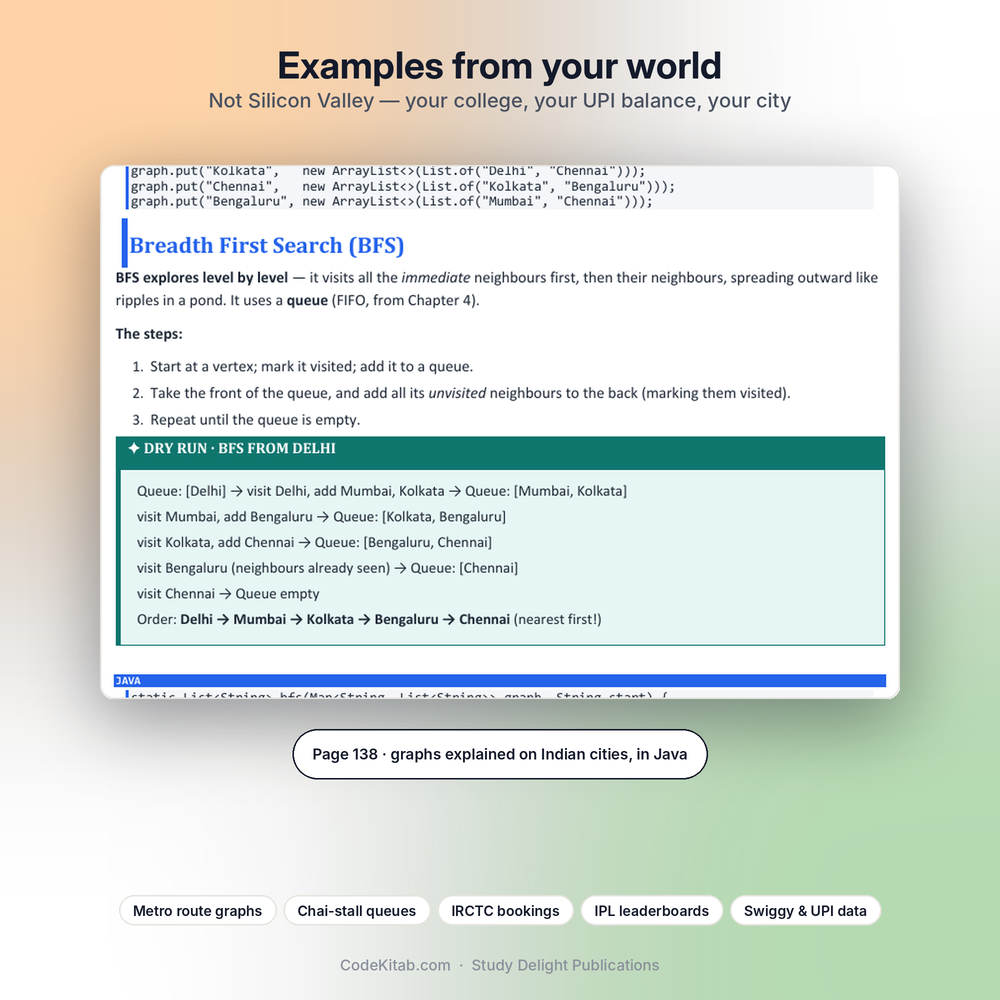
DSA with Java for Indian Students teaches data structures and algorithms the way they are actually tested — in college exams, in placement coding rounds and in technical interviews. Every structure is drawn first, then coded in Java, then explained line by line with examples from your world: metro route graphs, chai-stall queues, IRCTC bookings, IPL leaderboards.

Why Choose This DSA Book?

  • Written for Indian students — examples, contexts and exam patterns you actually recognise, matched to B.Tech, MCA and BCA syllabi
  • Every program tested and runnable — the output printed in the book is the real output
  • Placement-ready — 9 coding patterns, a 30-day plan and the top 50 interview questions
  • Visual learning — every structure drawn before it is coded

Who Is This Book For?

  • B.Tech / B.E. students taking Data Structures (sem 3–5)
  • MCA, BCA and BSc Computer Science students
  • Students preparing for placement coding rounds and interviews
  • Self-learners who know Java basics and want to think in algorithms

What You Will Learn

  • Introduction to DSA & algorithm analysis
  • Arrays & strings · Searching & sorting
  • Stacks & queues · Linked lists
  • Hashing, maps & sets · Trees & heaps · Graphs
  • Recursion, dynamic programming & greedy
  • Placement preparation & interview guide

Book Details

Title DSA with Java for Indian Students
Publisher CodeKitab (Study Delight Publications)
Language English
Format Paperback, full colour
Pages 176
Size A4
Edition First Edition
ISBN 9788168869172
Nishant and 933 people purchased
  • ✓ Premium & Fully Colorful
  • ✓ Gen Z approved
  • ✓ Practice with solutions included
  • ✓ Designed for Indian Students
Select Books
  • Estimated arrival October 27
  • Top Hot Selling Book
  • Free Shipping on Prepaid

SELLING OUT FAST

Due to high demand, limited quantities available

53% SOLD

See what our customers are saying...

"One of the best educational books I've purchased. Clear explanations and well-organized content."
Priya Verma
Priya Verma
Verified Customer
"Finally, a programming book truly designed for Indian students. The simple explanations, colorful presentation, and practical approach make learning much easier than traditional textbooks."
Arjun Mehta
Arjun Mehta
Verified Customer
"Simple explanations and practical programs. Exactly what I was looking for."
Aditya Kumar
Aditya Kumar
Verified Customer
"One of the best programming books I've purchased during my college journey."
Sneha Gupta
Sneha Gupta
Verified Customer
"Excellent quality and very easy to understand. The colorful layout makes learning much more engaging."
Rahul Sharma
Rahul Sharma
Verified Customer

Inside the book

10 chapters, mapped to your syllabus.

  1. 1Introduction to DSA & Algorithm Analysisp.5
  2. 2Arrays & Stringsp.20
  3. 3Searching & Sortingp.39
  4. 4Stacks & Queuesp.58
  5. 5Linked Listsp.73
  6. 6Hashing, Maps & Setsp.93
  7. 7Trees & Heapsp.112
  8. 8Graphsp.131
  9. 9Recursion, Dynamic Programming & Greedyp.148
  10. 10Placement Preparation & Interview Guidep.166

See a real page

Examples from your world, in full colour.

DSA with Java for Indian Students — example page
176pages, full colour
100%programs tested
A421 × 29.7 cm, laminated

Straight from the pages

Indian examples, straight from this book.

Real pages from DSA with Java for Indian Students. Every card names the chapter and page.
Creating arrays: Aarav, Diya, Kabir and an IPL table
DSA with JavaArrays & Strings · p.22
Creating arrays: Aarav, Diya, Kabir and an IPL table
Five ways to make an array, ending with a nested mini IPL points table.
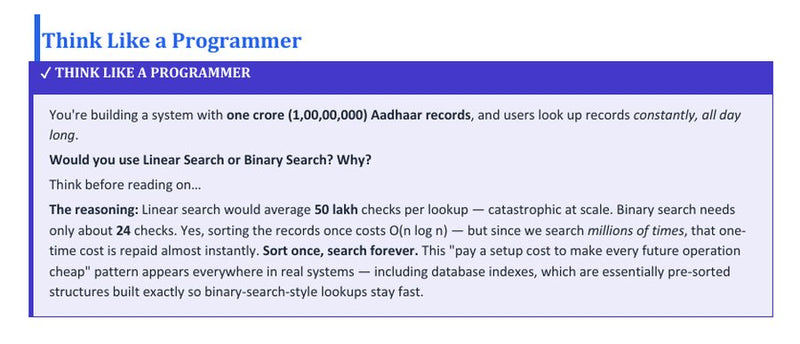
One crore Aadhaar records
DSA with JavaSearching & Sorting · p.43
One crore Aadhaar records
Think like a programmer: linear vs binary search at Indian scale.
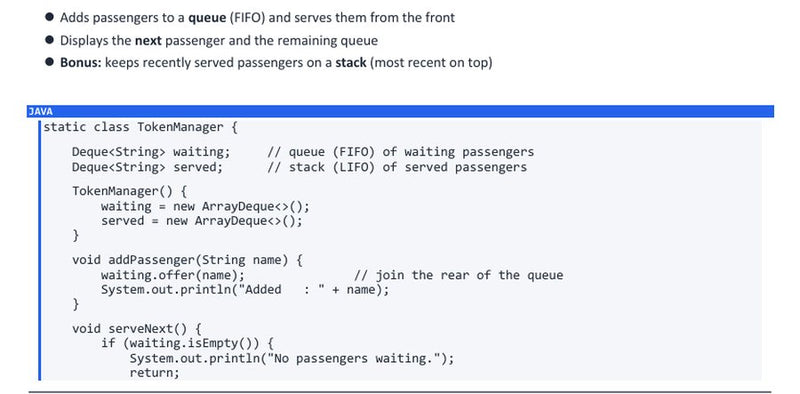
Mini Project: Railway Ticket Token Manager
DSA with JavaStacks & Queues · p.71
Mini Project: Railway Ticket Token Manager
An ArrayDeque of waiting passengers and a stack of served ones.
The IPL knockout is a tree
DSA with JavaTrees · p.114
The IPL knockout is a tree
Playoffs, semis, final: a single-elimination tournament is a binary tree.
Creating arrays: Aarav, Diya, Kabir and an IPL table
DSA with JavaArrays & Strings · p.22
Creating arrays: Aarav, Diya, Kabir and an IPL table
Five ways to make an array, ending with a nested mini IPL points table.
One crore Aadhaar records
DSA with JavaSearching & Sorting · p.43
One crore Aadhaar records
Think like a programmer: linear vs binary search at Indian scale.
Mini Project: Railway Ticket Token Manager
DSA with JavaStacks & Queues · p.71
Mini Project: Railway Ticket Token Manager
An ArrayDeque of waiting passengers and a stack of served ones.
The IPL knockout is a tree
DSA with JavaTrees · p.114
The IPL knockout is a tree
Playoffs, semis, final: a single-elimination tournament is a binary tree.
IRCTC Tatkal is a queue
DSA with JavaIntroduction · p.19
IRCTC Tatkal is a queue
FIFO explained with Tatkal booking order, then a marks challenge.
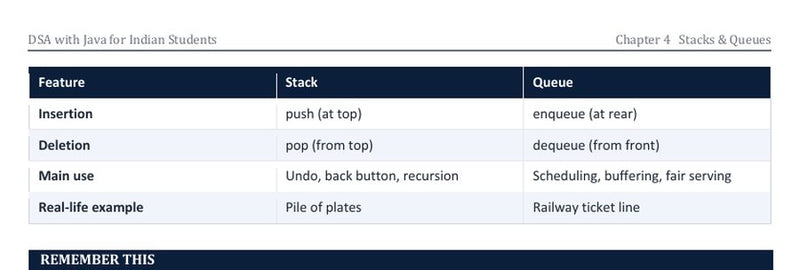
Pile of plates vs railway ticket line
DSA with JavaStacks & Queues · p.68
Pile of plates vs railway ticket line
Stack vs Queue: real-life example, order rule, main use.
Attendance list: Aarav, Diya, Kabir, Meera
DSA with JavaLinked Lists · p.92
Attendance list: Aarav, Diya, Kabir, Meera
Add, remove, search and reverse a linked list of students.
Delhi, Mumbai, Kolkata, Bengaluru, Chennai
DSA with JavaGraphs · p.133
Delhi, Mumbai, Kolkata, Bengaluru, Chennai
Graph words explained with a city map: neighbours, path, cycle, degree.
IRCTC Tatkal is a queue
DSA with JavaIntroduction · p.19
IRCTC Tatkal is a queue
FIFO explained with Tatkal booking order, then a marks challenge.
Pile of plates vs railway ticket line
DSA with JavaStacks & Queues · p.68
Pile of plates vs railway ticket line
Stack vs Queue: real-life example, order rule, main use.
Attendance list: Aarav, Diya, Kabir, Meera
DSA with JavaLinked Lists · p.92
Attendance list: Aarav, Diya, Kabir, Meera
Add, remove, search and reverse a linked list of students.
Delhi, Mumbai, Kolkata, Bengaluru, Chennai
DSA with JavaGraphs · p.133
Delhi, Mumbai, Kolkata, Bengaluru, Chennai
Graph words explained with a city map: neighbours, path, cycle, degree.
8 of the 50+ examples inside.

Who this book is for

B.Tech / B.E. DSA paper, sem 3–5 University exam pattern questions
MCA · BCA Data structures in Java Visual explanations for vivas
Placement prep Coding rounds and interviews 30-day plan + top 50 questions
Self-learners Java basics known Want to think in algorithms
Why students switch
>_CodeKitab
Typical textbook
Examples
Metro route graphs, Chai-stall queues, IRCTC bookings
Generic foo/bar
Pages
Full colour, visual
Black & white text
Exam prep
University-pattern questions
Theory only
Language
Plain, simple English
Dense academic
Placement
30-day plan + top 50 questions
Not covered

Real results you can see

Same student. Same laptop. Different book.

Compare the traditional way of learning with the CodeKitab approach: Indian examples, colour pages and exam-pattern questions.

Student struggling with a traditional textbook
BeforeTraditional textbook
Student learning with DSA with Java for Indian Students
AfterDSA with Java for Indian Students
4.8 / 5from 136 verified reviews
176full-colour pages
100%programs tested before print
Translation missing: en.accessibility.skip_to_reviews

what our customers say about us

4.8

Based on 16 Reviews

4.8
731 Reviews
624%
104%
3%
0%
0%

Review this product

Share your thoughts with other customers

R
Rahul Sharma – Delhi
Verified Buyer
DSA finally feels easier to understand.
The book explains data structures and algorithms in a very structured way without making the concepts unnecessarily complicated. The visual diagrams and Java examples helped me understand things like linked lists, trees, graphs, and sorting much more clearly.
P
Priya Verma – Lucknow
Verified Buyer
A great book for starting DSA with Java.
I was initially confused about where to begin with DSA, but this book provides a clear learning path. The visual explanations and practical Java code make difficult concepts much easier to understand and remember.
A
Aman Gupta – Noida
Verified Buyer
Excellent combination of concepts, visuals, and coding practice.
What I liked most is that the book doesn't just explain algorithms theoretically. The Java implementations and visual representations helped me understand how the algorithms actually work. Very useful for college and placement preparation.
S
Sneha Patel – Ahmedabad
Verified Buyer
The visual approach makes DSA much less intimidating.
Trees, graphs, stacks, queues, and linked lists can be difficult to visualize from traditional textbooks. This book explains them in a much more engaging way, and the colorful presentation makes long study sessions easier.
A
Aditya Singh – Jaipur
Verified Buyer
Really helpful for building strong DSA fundamentals.
The topics are arranged logically, starting with the basics and gradually moving toward more advanced concepts. I especially liked the complexity analysis and the placement guide at the end because they helped me understand how to approach interview problems.
A
Ananya Reddy – Hyderabad
Verified Buyer
Perfect for students learning DSA with Java.
The Java implementations are simple enough to follow while still teaching the actual logic behind the algorithms. The diagrams and examples made it much easier for me to connect the theory with the code.
V
Vivek Mishra – Varanasi
Verified Buyer
Very useful for placement preparation.
I bought this book mainly to strengthen my DSA fundamentals before placements. The coverage of searching, sorting, trees, graphs, recursion, and dynamic programming, plus the interview guide, has been really helpful for my coding practice.
N
Neha Gupta – Pune
Verified Buyer
Much easier to revise than traditional DSA books.
The visual presentation and well-organized chapters make it easy to go back and revise important concepts. I particularly liked the combination of diagrams, Java code, complexity analysis, and practical examples.
R
Rohan Mehta – Bengaluru
Verified Buyer
A modern way to learn Data Structures and Algorithms.
The book makes DSA feel more practical instead of purely theoretical. The visual learning approach helped me understand how different data structures work, while the Java examples gave me enough practice to start solving problems myself.
A
Arjun Kumar – Chandigarh
Verified Buyer
Finally, a DSA book designed with Indian students in mind.
The explanations are simple, the examples are relatable, and the visual approach makes complicated concepts easier to grasp. I especially liked the focus on coding patterns and placement preparation. A very useful resource for students.

Questions students ask

Is this DSA book suitable for complete beginners?

Yes. The book starts with the fundamentals of Data Structures and Algorithms and gradually progresses to more advanced concepts using simple explanations, visual learning, and Java examples.

Who is this DSA book for?

It is ideal for B.Tech/BE, BCA, B.Sc. Computer Science, MCA, diploma students, and anyone who wants to learn DSA using Java.

Do I need prior DSA knowledge?

No. The book is designed to take you from the basics and build your understanding step by step. Basic familiarity with Java is helpful but not essential for understanding the explanations.

Is the book designed specifically for Indian students?

Yes. That's a core part of the book's approach. It is created with the learning needs of Indian college students in mind, including practical learning and placement preparation.

What topics are covered in the book?

The book covers Algorithm Analysis, Arrays, Strings, Searching, Sorting, Stacks, Queues, Linked Lists, Hashing, Maps & Sets, Trees, Heaps, Graphs, Recursion, Dynamic Programming, Greedy Algorithms, and a dedicated Placement Preparation & Interview Guide.

Does the book use Java for implementing DSA?

Yes. Data structures and algorithms are explained and implemented using Java, allowing you to learn both the underlying logic and how to write the code.

Can I use this book for self-learning?

Yes. The book is written in simple, easy-to-understand language, making it perfect for self-study without requiring prior classroom instruction.

Does the book explain time and space complexity?

Yes. Complexity analysis is integrated into the learning process so you can understand not only how an algorithm works, but also how efficiently it performs.

Can I use this book for college exams as well as placements?

Absolutely. The book is designed to support both academic learning and practical problem-solving, making it useful for college coursework, semester preparation, coding practice, and placement preparation.

You may also like

DSA with Java for Indian Students — cover

DSA with Java for Indian Students

Sale price  Rs. 499.00 Regular price  Rs. 799.00